
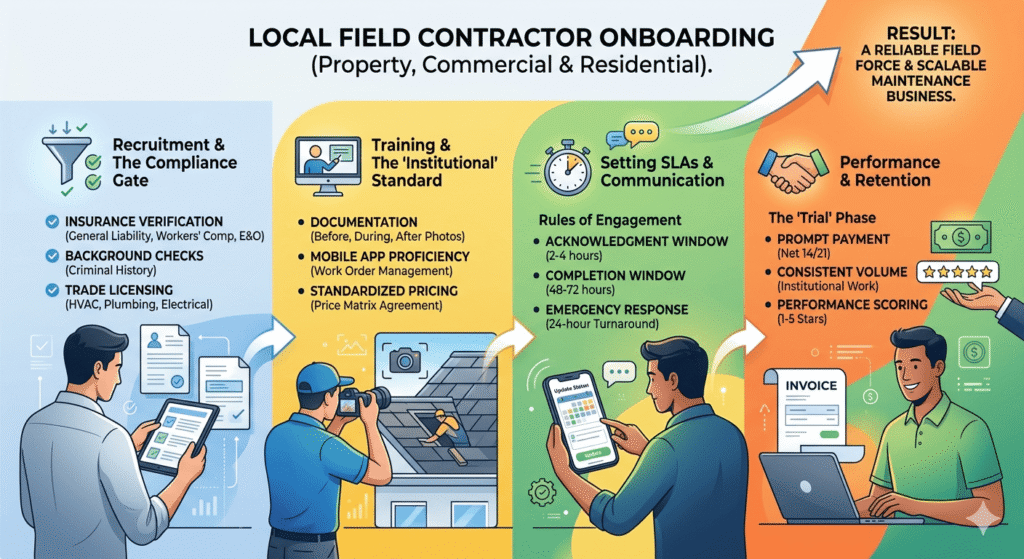
In the maintenance industry, you are only as good as your last work order. Whether you are managing a bank-owned foreclosure, a commercial storefront, or a residential rental, the “onboarding” phase is where you set the expectations that prevent late-night emergencies and rejected invoices.
To scale a maintenance arbitrage or coordination business, you must move away from “handshake deals” and toward a rigorous, repeatable onboarding system.
1. The Compliance “Filter”
Before a contractor is even considered for a job, they must pass the compliance gate. In property preservation, liability is your greatest enemy.
- Insurance Verification: At a minimum, require General Liability ($1M+), Workers’ Comp (or a valid waiver), and specifically Errors & Omissions (E&O) for preservation-specific tasks.
- Background Checks: Essential for residential work where contractors may enter occupied homes. Use a third-party service to verify criminal history.
- Trade Licensing: Ensure your vendors hold valid state-specific licenses for specialized trades like HVAC, plumbing, or electrical work.
2. The “Institutional” Training
Most local contractors are excellent at their craft but struggle with the administrative demands of institutional clients. Your onboarding must bridge this gap.
- The Power of Photos: Train vendors on the “Before, During, and After” (BDA) protocol. An institutional fund will not pay for a roof repair if the photos don’t clearly show the damage, the progress, and the final result with date/time/GPS stamps.
- Mobile App Proficiency: If you use a work order management platform, the contractor’s ability to update status in real-time is non-negotiable.
- Standardized Pricing: Onboard them onto your price list (Price Matrix) early to avoid haggling on every individual work order.
3. Communication & Service Level Agreements (SLAs)
Onboarding is the time to set the “Rules of Engagement.” If a contractor doesn’t know your timelines, they will miss them.
- Acknowledgment Window: Vendors should agree to acknowledge a work order within 2 to 4 hours.
- Completion Window: Standard preservation tasks (like grass cuts or debris removal) should typically be completed within 48 to 72 hours.
- Emergency Response: Define what constitutes an emergency (e.g., active water leaks) and ensure your “A-List” vendors are prepared for 24-hour turnarounds.
4. The “Trial” Phase
Never give a new contractor a 20-property portfolio on day one.
- The Pilot Project: Start with one or two small residential tasks. This allows you to evaluate their communication, photo quality, and punctuality without risking a major commercial contract.
- Performance Scoring: Use a simple scorecard (1–5 stars) based on quality, documentation, and speed. High-scoring vendors get the first pick of high-ticket commercial leads.
5. Incentivizing Long-Term Partnership
Retention is just as important as recruitment. Onboarding should also highlight why contractors should want to work with you.
- Prompt Payment: In an industry where “Net 60” is common, offering faster payment terms (like Net 14 or Net 21) will make you a local contractor’s favorite client.
- Consistent Volume: Explain that by following your systems, they gain access to a steady stream of institutional work without having to do their own marketing.
The Final Word
Onboarding local field contractors is about creating a culture of accountability. By filtering for compliance, training for documentation, and rewarding performance, you transform a disorganized group of “handymen” into a professional field force capable of handling the most demanding institutional portfolios.
A strong onboarding process doesn’t just protect your business—it builds a moat around it.