
Digital Maintenance Arbitrage is a high-ticket business model that combines the scalability of digital drop-servicing with the recession-proof stability of the property maintenance industry.
Unlike traditional affiliate marketing, where you earn small commissions on digital goods, maintenance arbitrage focuses on coordinating high-value physical services between institutional clients (like banks and hedge funds) and local field contractors.
1. The Core Concept: How It Works
At its heart, digital maintenance arbitrage is a service-based brokerage. You act as the digital operations hub that connects demand with labor.
- The Demand: Institutional clients (REITs, banks, property groups) have thousands of properties that require constant upkeep—grass cuts, debris removal, roof repairs, and winterization.
- The Labor: Local, “boots-on-the-ground” contractors who have the tools but often lack the digital infrastructure or marketing reach to land massive corporate contracts.
- The Arbitrage: You secure the contract at a professional corporate rate (e.g., $1,500 for a turnover) and outsource the work to a vetted local vendor at a fair field rate (e.g., $1,000). You keep the $500 spread as a management and coordination fee.
2. Why “Digital”?
The “Digital” aspect refers to your ability to run this business entirely remote. You are not swinging a hammer; you are managing data. Your primary tools are:
- Work Order Management Systems: Digital portals where you receive, assign, and track tasks.
- Cloud-Based Documenting: Institutional clients require extensive photo documentation (Before, During, and After photos). You manage the flow of these digital assets to ensure payment.
- High-Ticket Lead Gen: Using LinkedIn outreach, Facebook Ads, or professional marketplaces (like Whop or BlackHatWorld) to find both high-level clients and reliable vendors.
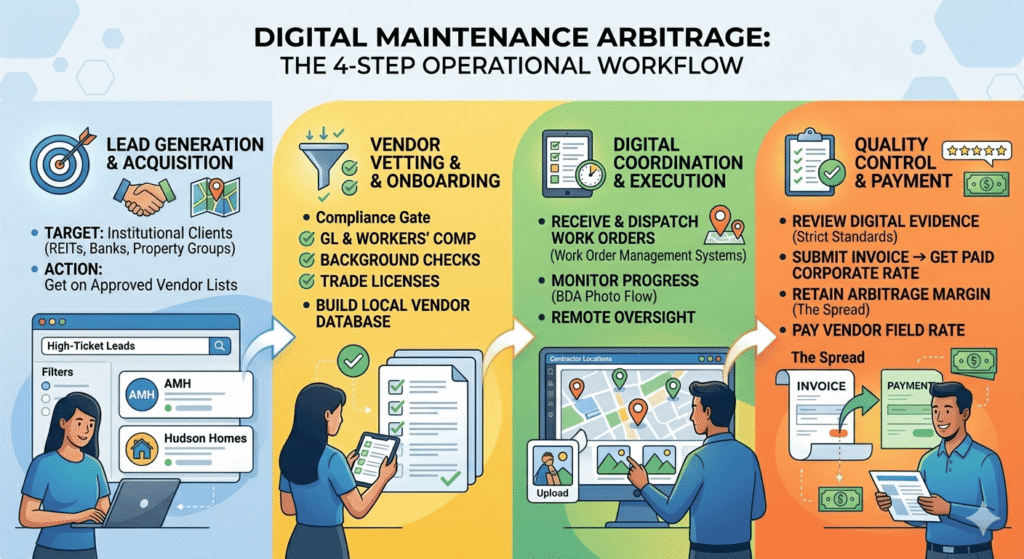
3. The 4-Step Operational Workflow
I. Lead Generation & Acquisition
You focus on finding “Institutional Leads.” These are companies that manage hundreds of “Single Family Rentals” (SFRs) or foreclosed assets. Your goal is to get on their “Approved Vendor List.”
II. Vendor Vetting (The Supply)
You build a database of local field contractors. During onboarding, you verify their:
- GL & Workers’ Comp Insurance
- Background checks
- Trade licenses (HVAC, Plumbing, etc.)
III. Execution & Monitoring
When a work order arrives, you dispatch it digitally to the nearest local contractor. You monitor their progress via GPS-stamped photos uploaded to your system.
IV. Quality Control & Arbitrage
Once the work is done, you review the digital evidence. If it meets the client’s strict standards, you submit the invoice. The client pays you, you pay the contractor, and you retain the arbitrage margin.
4. Key Advantages Over Other Models
| Feature | Affiliate Marketing | Maintenance Arbitrage |
| Stability | Vulnerable to algorithm shifts | Essential “Physical” necessity |
| Profit Margins | 3% – 10% (Low) | 20% – 40% (High-Ticket) |
| Scalability | High, but highly competitive | High via remote coordination |
| Barrier to Entry | Low (Anyone can do it) | Moderate (Requires industry knowledge) |
5. Potential Challenges
- Quality Control: Since you aren’t on-site, you must have a “Trust but Verify” system using strict photo documentation requirements.
- Compliance Risks: Ensuring all vendors carry active insurance is critical to protecting your business from liability.
- Intellectual Property: As you build your unique “Price Matrix” and vendor lists, securing your data becomes a priority to prevent competitors from copying your model.
Digital Maintenance Arbitrage is about owning the bridge. By digitizing the management of a physical industry, you create a business that is difficult to replicate, highly profitable, and resilient against economic downturns. It’s not just about getting the job done; it’s about managing the information that ensures the job is done right.