
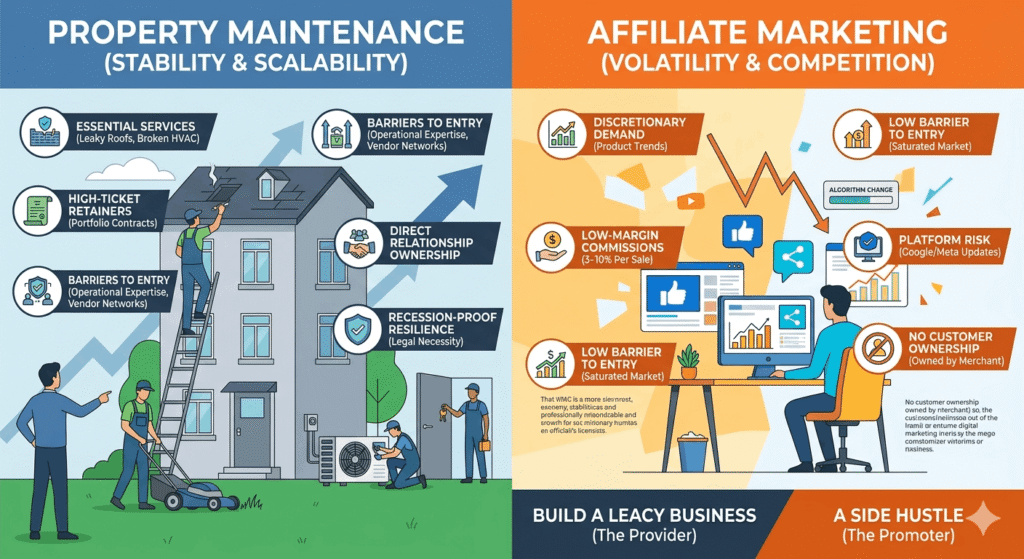
The digital landscape is shifting. For years, affiliate marketing was hailed as the ultimate “passive income” dream. However, as algorithms become more volatile and markets more saturated, many are looking toward the Property Maintenance sector as a more robust, scalable, and defensible business model.
While affiliate marketing relies on the whims of third-party platforms, property maintenance is built on the bedrock of physical necessity. Here is why the maintenance sector is a superior choice for long-term growth.
1. Tangible Value vs. Arbitrary Algorithms
In affiliate marketing, your income is often at the mercy of a single algorithm update. If a search engine changes how it ranks “best of” lists or a social platform throttles organic reach, an affiliate business can vanish overnight.
Property Maintenance deals with “non-discretionary” needs. A leaking roof, a broken HVAC system, or a required turnover for a rental unit cannot be ignored. These are physical problems that require coordination and solutions, making the demand consistent regardless of what happens in the digital advertising world.
2. High-Ticket Retainers vs. Low-Margin Commissions
Most affiliate programs offer small percentages—often ranging from 3% to 10%—meaning you need massive traffic volume to see significant returns. Furthermore, you are constantly fighting “cookie-stuffing” and attribution theft.
In contrast, property maintenance—specifically the Maintenance Arbitrage model—focuses on high-ticket contracts. Managing the maintenance for institutional clients or Real Estate Investment Trusts (REITs) involves large-scale portfolios. A single successful contract can yield more consistent monthly revenue than thousands of affiliate clicks.
3. Barriers to Entry and Defensibility
Affiliate marketing has a near-zero barrier to entry, which leads to extreme competition and “race to the bottom” pricing. Because anyone can start a blog or a social media page, the space is crowded with low-quality content.
Property maintenance requires operational expertise, vendor networks, and industry knowledge. These barriers to entry act as a “moat” for your business. Once you have established relationships with local vendors and institutional clients, you aren’t just another link in a chain; you are a critical infrastructure partner.
4. Direct Relationship Ownership
In affiliate marketing, you don’t own the customer—the merchant does. You are simply a middleman who gets paid a finders fee.
In the maintenance sector, you own the relationship.
- You control the communication with the property fund.
- You manage the vendor network.
- You hold the data and the history of the property’s upkeep. This ownership allows you to cross-sell services, increase your margins over time, and build a brand with actual resale value.
5. Recession-Proof Resilience
When the economy dips, marketing budgets are often the first to be cut. Affiliate spending drops as consumers tighten their belts on discretionary purchases.
However, property preservation is a legal and financial necessity. Banks, hedge funds, and landlords must maintain their assets to protect their investments and comply with local habitability laws. Whether the market is booming or corrected, grass needs cutting, locks need changing, and properties must be secured.
| Feature | Affiliate Marketing | Property Maintenance |
| Demand Type | Discretionary / Interest-based | Essential / Non-discretionary |
| Platform Risk | High (Google/Meta updates) | Low (Contract-based) |
| Profit Margins | Low (Small percentages) | High (Service fees/Arbitrage) |
| Customer Ownership | None (Owned by merchant) | Full (Owned by you) |
| Stability | Volatile | Consistent |
Affiliate marketing remains a viable side hustle for some, but for those looking to build a scalable enterprise, property maintenance offers a level of security and professional authority that digital-only models simply cannot match. By focusing on the coordination of physical services, you move from being a “promoter” to a “provider”—a shift that defines the difference between a hobby and a legacy business.